
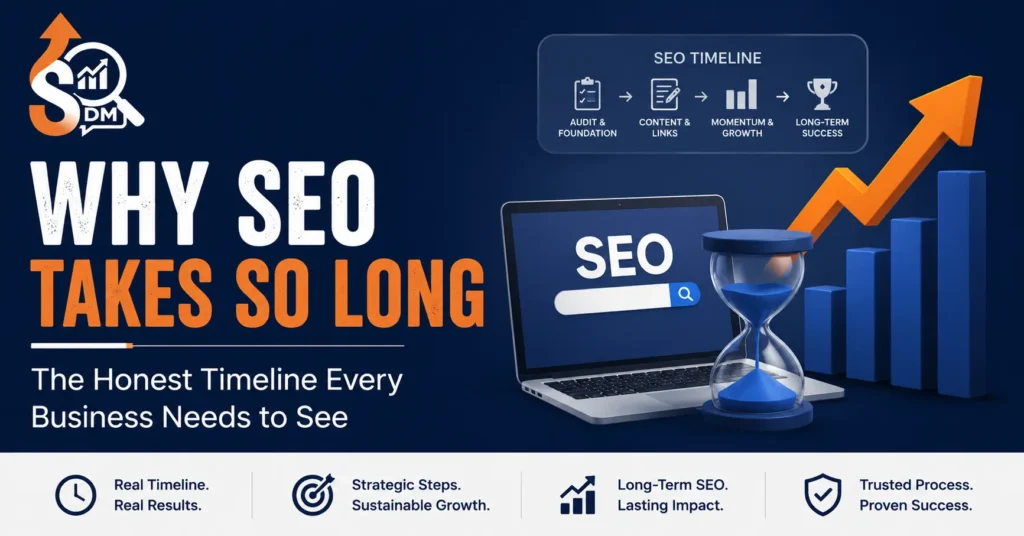
Most businesses start SEO with one question: “How long does SEO take?”
It’s a fair question and one that often comes with frustration. You’ve invested in a new website, published content, or hired an SEO agency, yet weeks go by without seeing your website on the first page of Google.
The truth is that SEO takes time because search engines need time to discover, understand, evaluate, and trust your website. Unlike paid advertising, where visibility begins as soon as your campaign goes live, search engine optimization is a long-term strategy built on relevance, authority, and consistency.
If you’ve ever wondered why SEO takes long, you’re not alone. Many business owners expect immediate rankings, but Google’s algorithm evaluates hundreds of ranking signals before deciding where a page deserves to appear. That process simply cannot be rushed overnight.
For most businesses, meaningful improvements begin within 3 to 6 months, while stronger and more sustainable growth typically happens between 6 and 12 months. The exact SEO timeline depends on your industry, competition, website history, technical health, and content quality.
This guide explains what actually happens during each stage of an SEO campaign, why patience pays off, and what you can do to accelerate your results without cutting corners.
Why SEO Takes Time in the First Place
Before looking at the timeline, it’s important to understand what happens behind the scenes. When you publish a new page, Google doesn’t instantly rank it. Instead, it follows a meticulous, multi-step process:
- Crawls your website to discover new pages.
- Indexes the content securely.
- Understands the core topic and underlying search intent.
- Evaluates content quality, depth, and expertise.
- Measures user experience (UX) and technical performance.
- Compares your page against competing websites.
- Tests your rankings for different search queries.
- Refines rankings continuously as new signals arrive.
This process relies on hundreds of ranking factors, including technical SEO, keyword relevance, topical authority, backlinks, website performance, internal linking, content freshness, and user engagement. That’s why SEO isn’t a quick fix—it’s a process of building trust with both search engines and your audience.
Month 1–2: Audit and Build the Foundation
The first two months rarely produce dramatic ranking improvements, and that’s completely normal. This stage focuses on creating a strong foundation rather than chasing quick wins.
A professional SEO campaign usually begins with a comprehensive audit to identify technical issues preventing search engines from properly crawling and indexing your website. Broken links, duplicate pages, slow loading speeds, poor Core Web Vitals, missing metadata, and crawl errors all need attention before content can perform at its best.
At the same time, keyword research becomes the roadmap for future growth. Instead of targeting random keywords, your SEO strategy should focus on search intent, topical relevance, and realistic opportunities.
Key Activities in This Phase
- Technical SEO audits & website architecture improvements
- In-depth keyword research & competitor analysis
- Search intent mapping & content planning
- Robust internal linking strategy
- Schema markup implementation
- Google Search Console & Google Analytics configuration
Why Aren’t Rankings Improving Yet?
In reality, Google is still actively collecting data about your website. During this period, search engines are busy discovering your pages, re-crawling updated content, and understanding your site structure. The goal isn’t immediate rankings—it’s building a website Google can confidently trust.
Early SEO Success Indicators
Instead of focusing only on traffic, monitor these early signs of progress:
- More pages getting successfully indexed.
- Increased impressions in Google Search Console.
- Better crawl activity and frequency from Googlebot.
- Improved Core Web Vitals scores.
- Reduced technical and crawl errors.
Month 3–4: Content, Authority, and Google’s First Signals
By months three and four, your strategy shifts from preparation to growth. This is when consistent, high-quality content works alongside technical SEO to build topical authority.
Instead of publishing isolated blog posts, successful websites create content clusters that answer related questions across the customer journey. This helps Google understand your expertise and strengthens your visibility across multiple keywords rather than just one.
Focus Areas for This Stage
- Publishing highly optimized blog content and service pages.
- Building topical authority through strategic clusters.
- Strengthening internal links and earning high-quality backlinks.
- Improving E-E-A-T (Experience, Expertise, Authoritativeness, and Trustworthiness) signals.
- Optimizing images and structured JSON-LD data.
- Refreshing and updating older content.
Google also begins testing your pages for different search queries. Rankings may fluctuate significantly during this period as the algorithm determines where your content belongs. Don’t panic if positions rise and fall; ranking volatility is completely normal while Google evaluates user satisfaction.
Month 5–6: Momentum Starts Compounding

This is where many successful SEO campaigns begin accelerating. SEO behaves much like compound interest.
Every optimized page strengthens your website. Every quality backlink increases authority. Every internal link helps Google discover more content. Over time, these improvements work together, creating momentum that’s difficult for competitors to replicate.
Many businesses experience their biggest growth between months five and six because Google has accumulated enough trust to consistently rank more pages.
Expected Milestones
- More first-page keyword rankings for target terms.
- Faster indexing of brand-new content.
- Noticeable increases in organic traffic and click-through rates (CTR).
- More qualified, high-intent leads.
- Enhanced brand visibility and conversion opportunities.
What Can Slow Down Your SEO Results?
Not every website follows the same timeline. Several critical factors can delay your progress:
- Highly competitive industries or targeting overly broad keywords.
- Brand-new domains lacking established sandbox trust.
- Weak website architecture or poor technical SEO.
- Thin, unhelpful, or duplicate content.
- Low-quality or toxic backlink profiles.
- Inconsistent publishing schedules.
- Ignoring user experience (UX) and mobile responsiveness.
What You Can Do to Speed Up SEO
Although you can’t force Google to rank your website overnight, you can remove obstacles that slow progress. The most effective ways to accelerate your SEO timeline include:
- Fix technical issues before launching major content campaigns.
- Publish high-quality, NLP-optimized content consistently.
- Target long-tail keywords with realistic competition first.
- Build deep topical authority through structured content hubs.
- Earn authoritative backlinks naturally through high-value assets.
- Optimize heavily for Core Web Vitals and page speed.
- Keep content fresh by regularly updating outdated information.
- Optimize for featured snippets and AI search experiences (GEO).
SEO Timeline by Business Type
Different industries and business models experience different paths to ranking success.
| Business Type | Typical SEO Timeline | Primary Focus Area |
| Local Business | 3–6 months | Local Citations & Google Business Profile |
| Small Business | 4–8 months | Long-tail Keywords & Content Clusters |
| Ecommerce Store | 6–12 months | Technical SEO, Product Schema & Category Content |
| SaaS Company | 6–12 months | Topical Authority & Comparative Content |
| National Brand | 8–12 months | High-authority Link Building & Scale |
| Enterprise Website | 12+ months | Crawl Budget Optimization & Site Architecture |
Frequently Asked Questions
Why does SEO take so long?
SEO takes time because Google must crawl, index, evaluate, and compare your content against established competitors before assigning rankings. Building trust, authority, and authentic user signals cannot happen instantly.
How long does SEO take to show results?
Most businesses begin seeing measurable improvements within 3 to 6 months, while stronger, compounding organic growth often develops after 6 to 12 months.
Can SEO work in one month?
You may see technical improvements, faster indexing, and increased impressions within the first month, but meaningful first-page rankings and substantial traffic growth usually require several months of consistent optimization.
Is SEO still worth the investment?
Yes. Unlike paid advertising, where traffic stops the moment you stop paying, SEO builds long-term digital assets that continue generating qualified traffic and leads long after the content is published.
Start Your SEO Journey Today
SEO isn’t about chasing overnight rankings—it’s about building a sustainable source of qualified traffic that continues delivering results month after month.
If you’re ready to invest in a long-term strategy backed by technical expertise, data-driven content, and ethical optimization, explore our SEO services. Our team focuses on building lasting organic growth through technical SEO, strategic content marketing, authoritative link building, and continuous performance improvement.
The sooner you start building your online authority, the sooner your website can benefit from the compounding power of organic search.