
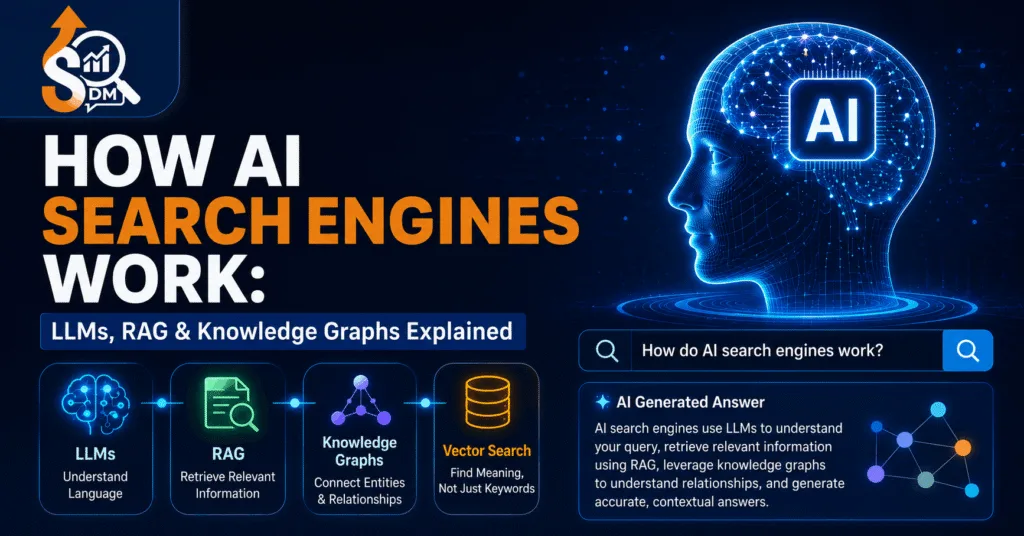
Search has changed dramatically over the last few years. Instead of returning a list of blue links, AI search engines can understand questions, gather information from multiple sources, and generate complete answers in seconds. Platforms like ChatGPT Search, Google AI Mode, Google AI Overviews, Perplexity, and Microsoft Copilot are changing how people discover information and how websites earn visibility.
This shift means website owners, marketers, and SEO professionals need to understand more than traditional ranking factors. Modern AI search relies on technologies such as Large Language Models (LLMs), Retrieval-Augmented Generation (RAG), Knowledge Graphs, vector embeddings, and semantic search to produce accurate, contextual answers. Learning how these technologies work together helps you create content that both people and AI systems can understand, trust, and reference.
In this guide, we’ll break down the complete AI search process, explain the role of each core technology, and show why entity-based content has become a critical part of modern search optimization.
What Is an AI Search Engine?
An AI search engine is a search system that uses artificial intelligence to understand a user’s intent, retrieve relevant information, and generate direct answers instead of only displaying a list of web pages. Unlike traditional search engines that primarily match keywords and rank documents, AI search combines language understanding, semantic retrieval, and reasoning to answer questions in a more natural way.
When you ask a question such as, “How do AI search engines work?”, an AI-powered search engine doesn’t simply look for pages containing those exact words. Instead, it analyzes the meaning behind your query, identifies the concepts involved, retrieves supporting information from trusted sources, and produces a conversational response grounded in that information.
Several technologies work together during this process:
- Large Language Models (LLMs) interpret natural language, understand context, and generate human-like responses.
- Retrieval-Augmented Generation (RAG) supplies the model with fresh, relevant information from external sources before it creates an answer.
- Knowledge Graphs organize entities and their relationships, helping the system understand people, places, organizations, products, and concepts.
- Vector embeddings allow AI to search by meaning rather than relying only on exact keyword matches.
Together, these components enable AI search engines to provide answers that are more contextual, personalized, and informative than traditional keyword-based search.
Examples of Modern AI Search Engines
Several platforms now combine these technologies to deliver AI-generated search experiences:
- ChatGPT Search generates conversational answers while citing supporting web sources.
- Google AI Mode blends Google’s search index with generative AI to answer complex questions.
- Google AI Overviews summarize information from multiple trusted sources directly in search results.
- Perplexity AI combines real-time retrieval with cited responses, allowing users to verify information easily.
- Microsoft Copilot integrates web search with AI-assisted reasoning across Microsoft’s ecosystem.
Although each platform uses its own architecture and ranking systems, they all follow a similar goal: understand the user’s intent, retrieve trustworthy information, and generate a clear answer that saves users from visiting dozens of separate web pages.
This shift marks one of the biggest changes in search since Google’s introduction of PageRank. Success is no longer determined only by ranking for keywords. Websites also need to publish accurate, well-structured, entity-rich content that AI systems can interpret, connect, and confidently reference.
Traditional Search vs AI Search: What Changed?
For more than two decades, traditional search engines helped users find information by indexing billions of web pages and ranking them based on relevance, authority, and hundreds of other ranking signals. The goal was simple: show the most useful pages so users could click through and find their own answers.
AI search changes that experience. Instead of acting only as a directory of web pages, it works as an intelligent assistant that understands questions, gathers supporting information, and generates complete responses. The focus shifts from finding documents to delivering answers.
How Traditional Search Works
A traditional search engine follows a structured process:
1. Crawling
Search bots continuously discover new pages by following links across the web. They collect information about each page and revisit websites to detect updates.
2. Indexing
After crawling, the search engine analyzes the content, extracts important signals, and stores the page in a searchable index. This process helps the engine understand topics, keywords, links, images, and metadata.
3. Ranking
When someone submits a query, the search engine compares it against its index and ranks matching pages based on relevance, page quality, authority, user experience, freshness, and many other ranking factors.
4. Displaying Results
Finally, users receive a Search Engine Results Page (SERP) filled with links, featured snippets, images, videos, local listings, and other search features. The user still needs to open one or more pages to gather the complete answer.
This model has powered web search successfully for years, but it depends on users reading multiple sources before finding the information they need.
How AI Search Works
AI search expands this process by adding language understanding and reasoning before presenting an answer.
Instead of matching keywords alone, the system first interprets the meaning behind a question. It identifies the user’s intent, recognizes important entities, retrieves trustworthy information, and then uses an AI model to generate a clear response.
A simplified AI search workflow looks like this:
Step 1: Understand the query
The system analyzes natural language, identifies context, and determines what the user is actually asking.
Step 2: Retrieve relevant information
Instead of relying only on the model’s training data, AI search retrieves current information from search indexes, trusted websites, databases, or enterprise knowledge sources.
Step 3: Organize supporting evidence
Retrieved information is filtered, ranked, and connected using semantic relationships and entity understanding. Knowledge Graphs help identify how people, organizations, products, locations, and concepts relate to one another.
Step 4: Generate the answer
The Large Language Model combines the retrieved information with its language capabilities to produce a natural, conversational response instead of presenting only a list of links.
Step 5: Cite supporting sources
Many AI search platforms include citations or links to the sources used during answer generation, allowing users to verify information or explore topics in greater depth.
Traditional Search vs AI Search at a Glance
| Traditional Search | AI Search |
| Returns ranked web pages | Generates direct answers |
| Primarily keyword-focused | Understands intent and context |
| Users visit multiple websites | Users often receive complete answers immediately |
| Ranks documents | Synthesizes information from multiple sources |
| Relies heavily on keyword relevance | Uses entities, semantic relationships, and contextual understanding |
| Requires users to compare information | Summarizes information before presenting it |
These differences are changing how content is discovered online. Ranking on the first page is still valuable, but visibility in AI-generated answers increasingly depends on how well a website communicates expertise, covers a topic comprehensively, and establishes clear relationships between entities. Content that answers questions thoroughly, uses structured information, and demonstrates trustworthiness has a much better chance of being retrieved and cited by AI-powered search systems. Read more GEO vs SEO vs AEO.
The Four Core Technologies Behind AI Search
Every modern AI search engine relies on multiple technologies working together rather than a single AI model. While users only see a generated answer, several systems process the query, retrieve information, verify context, and produce a response. The four technologies below form the foundation of most AI-powered search platforms.
Large Language Models (LLMs): The Language Engine
Large Language Models (LLMs) are advanced AI models trained on massive collections of text, including books, research papers, websites, documentation, and other publicly available content. Their primary role is to understand language patterns and generate responses that sound natural and relevant.
Unlike traditional search algorithms that focus on matching keywords, LLMs analyze the relationships between words, phrases, and concepts. This allows them to understand context, recognize synonyms, and interpret complex questions even when the exact keywords are not present.
For example, if someone asks:
“Why does my website never appear in AI search results?”
An LLM understands that the user is asking about online visibility, AI-powered search platforms, content quality, authority, and search optimization. It doesn’t rely on finding pages with the exact wording of the question.
Modern LLMs use a Transformer architecture, which helps them process long passages of text while understanding how different words relate to one another. Instead of reading one word at a time, the model evaluates the relationships across an entire sentence or paragraph to build a deeper understanding of meaning.
Some key capabilities of LLMs include:
- Understanding conversational language
- Identifying user intent
- Recognizing entities and their relationships
- Summarizing complex information
- Generating human-like answers
- Following multi-step instructions
Despite these strengths, LLMs also have an important limitation. Their knowledge comes from the data they were trained on, which means they may not include recent events or newly published information. They can also produce incorrect statements, commonly known as hallucinations, when they generate responses without reliable supporting evidence.
This limitation led to the development of Retrieval-Augmented Generation.
Retrieval-Augmented Generation (RAG): Giving AI Access to Fresh Information
Retrieval-Augmented Generation (RAG) improves AI search by allowing a language model to retrieve relevant information before generating an answer. Instead of relying only on its training data, the model searches trusted external sources, retrieves useful content, and uses that information as context.
You can think of RAG as giving an AI assistant access to a constantly updated research library before it responds.
A typical RAG workflow follows these steps:
- A user submits a question.
- The system converts that question into a semantic search query.
- Relevant documents are retrieved from search indexes, databases, or trusted websites.
- The retrieved content is passed to the LLM.
- The LLM generates a response based on both its language knowledge and the retrieved information.
This process offers several advantages:
- Improves factual accuracy
- Uses current information instead of only historical training data
- Reduces hallucinations
- Supports source citations
- Delivers answers with stronger contextual relevance
This is why many AI search platforms can reference recent articles, product documentation, research papers, and news stories while answering user questions.
Without RAG, an LLM generates responses primarily from what it learned during training. With RAG, it can access updated information before composing an answer, making the response more reliable and grounded.
Knowledge Graphs: Understanding Entities and Relationships
A Knowledge Graph is a structured network that organizes information into entities and the relationships between them. Instead of storing isolated facts, it connects people, companies, products, locations, events, and concepts to show how they relate.
For example, consider the entity OpenAI.
A Knowledge Graph can connect OpenAI with related entities such as:
- ChatGPT
- GPT-4.1 and GPT-5 models
- Artificial intelligence
- Large Language Models
- Sam Altman
- Microsoft
- AI search
Rather than treating each topic separately, the graph understands that these entities are linked. This helps AI search engines interpret ambiguous queries and provide more accurate answers.
Knowledge Graphs improve AI search by:
- Understanding entity relationships
- Resolving ambiguous searches
- Connecting related concepts
- Improving semantic search accuracy
- Supporting more precise retrieval
- Providing context for generated answers
This is one reason modern SEO is moving toward entity optimization instead of relying only on keyword frequency. When your content clearly explains entities and their relationships, AI systems can understand your expertise more effectively.
Vector Embeddings: Searching by Meaning Instead of Keywords
Traditional search often depends on matching exact words. AI search uses vector embeddings to understand the meaning behind content.
A vector embedding is a mathematical representation of text that captures semantic meaning. Instead of storing words as plain text, AI converts sentences, paragraphs, or documents into numerical vectors. Content with similar meaning is placed closer together in a multidimensional vector space.
For example, these searches express the same intent:
- Best AI search engine
- Top AI search platform
- Which AI search tool should I use?
Although the wording differs, vector embeddings recognize that all three questions are closely related.
When a user submits a query, the system converts it into a vector and compares it against millions of document vectors stored in a vector database. Rather than looking for identical keywords, it retrieves documents with the closest semantic match.
This capability allows AI search engines to:
- Find relevant content even without exact keyword matches
- Understand synonyms and related concepts
- Retrieve contextually similar documents
- Improve search relevance for conversational queries
- Support multilingual and natural-language search
Vector embeddings serve as the bridge between a user’s intent and the information needed to answer it. Combined with LLMs, RAG, and Knowledge Graphs, they help AI search systems move beyond simple keyword matching and deliver responses that better reflect the meaning behind every search.
Step-by-Step: How an AI Search Engine Answers Your Question
The technologies we’ve discussed do not operate independently. Every AI search engine follows a connected workflow that transforms a simple question into a complete, evidence-based answer. While the exact architecture differs between platforms, most modern AI search systems follow a similar sequence.
Let’s walk through what happens behind the scenes.
Step 1: Understanding the User’s Intent
Everything begins with the user’s query.
Unlike traditional search, AI first focuses on understanding what the user actually wants, not just the words they typed.
For example, consider this search:
“How can my website appear in ChatGPT Search?”
The AI recognizes several important entities and concepts:
- Website
- ChatGPT Search
- AI visibility
- Search optimization
- Website authority
It also determines the search intent. In this case, the user isn’t asking for a definition. They’re looking for practical guidance on improving visibility in AI-powered search engines.
This intent detection allows AI to deliver a much more relevant response than keyword matching alone.
Step 2: Converting the Question into Semantic Meaning
After identifying the user’s intent, the search engine converts the query into vector embeddings.
Instead of storing the question as plain text, it creates a mathematical representation that captures its meaning. This allows the system to recognize related concepts even when different wording is used.
For example, these searches all express nearly the same intent:
- How do AI search engines work?
- How does ChatGPT Search find answers?
- How does generative search work?
- How do LLM search engines generate responses?
Although the wording changes, AI understands they belong to the same semantic topic.
This capability makes conversational search possible.
Step 3: Retrieving the Most Relevant Information
Once the semantic meaning is established, the retrieval system begins searching for supporting information.
Depending on the platform, information may come from:
- Web search indexes
- Knowledge bases
- Research papers
- Documentation
- Enterprise databases
- Internal company data
- Trusted online publications
Instead of retrieving pages with identical keywords, the system searches for documents that best match the meaning of the user’s request.
This retrieval stage is where RAG becomes essential.
Rather than asking the language model to answer from memory alone, AI provides it with fresh, relevant information before response generation begins.
Step 4: Understanding Entities Through the Knowledge Graph
Retrieved information often contains multiple entities that relate to one another.
For example, if someone searches:
“How does Google AI Overview use RAG?”
The system identifies entities such as:
- AI Overviews
- Retrieval-Augmented Generation
- Large Language Models
- Search
- Knowledge Graph
The Knowledge Graph maps the relationships between these entities, helping AI understand not only what each entity is but also how they connect.
This additional context reduces ambiguity and improves the overall quality of the final answer.
Step 5: Grounding the Language Model with RAG
After retrieval is complete, the selected information is passed to the Large Language Model.
Instead of relying only on its training knowledge, the model now receives supporting context from external sources.
This process is called grounding.
Grounding allows the LLM to:
- Reference recent information
- Improve factual accuracy
- Stay aligned with retrieved evidence
- Reduce unsupported statements
- Generate more trustworthy responses
Without grounding, even a powerful language model may confidently produce incorrect information.
Step 6: Generating a Natural Language Answer
The LLM combines:
- The user’s original question
- Retrieved documents
- Entity relationships
- Context from the Knowledge Graph
- Its own language capabilities
It then produces a response that reads like a conversation instead of a collection of search results.
Rather than copying information word for word, the model synthesizes multiple sources into a coherent explanation while maintaining context throughout the answer.
This is one of the biggest differences between AI search and traditional search engines.
Step 7: Ranking Confidence and Selecting Supporting Sources
Before presenting an answer, many AI search systems evaluate the quality and reliability of the information they retrieved.
Several factors influence which sources are referenced, including:
- Relevance to the user’s intent
- Topical authority
- Accuracy
- Freshness
- Source credibility
- Entity consistency
- Content completeness
Pages that explain a topic clearly, cover related entities, and provide well-structured information are more likely to become supporting sources in AI-generated responses.
Step 8: Delivering the Final Response
Finally, the AI presents its answer.
Depending on the platform, the response may include:
- A conversational explanation
- Source citations
- Related follow-up questions
- Images or videos
- Interactive suggestions
- Links for deeper reading
Instead of asking users to compare information across multiple web pages, AI organizes the most relevant information into a single response while still allowing users to explore the original sources if they want more detail.
Putting It All Together
The complete AI search workflow follows a logical sequence:
User Question → Intent Detection → Semantic Embeddings → Information Retrieval → Knowledge Graph Understanding → RAG Grounding → LLM Response Generation → Source Validation → Final AI Answer
Each stage builds on the previous one. If retrieval fails, the answer may lack important facts. If entity relationships are unclear, the AI may misunderstand the context. If the language model is not grounded with reliable information, the response becomes less trustworthy.
This interconnected workflow explains why modern AI search engines deliver answers that feel conversational while still relying on structured retrieval, semantic understanding, and trusted information behind the scenes.