
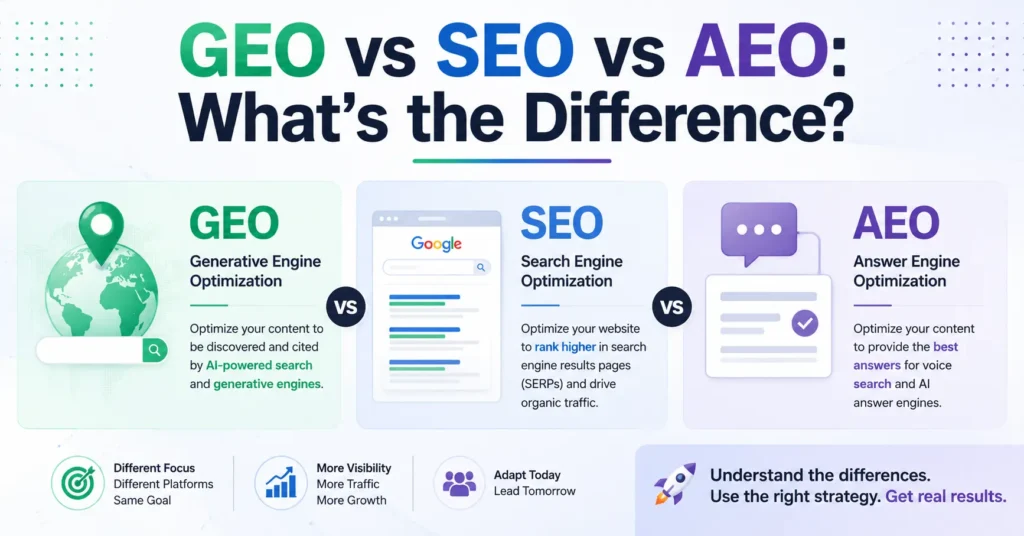
Search has split into three lanes. SEO gets you ranked in Google. AEO gets you quoted in a direct answer box. GEO gets you mentioned inside a ChatGPT or Gemini response. They share some tools, but each one plays a different game, and mixing them up costs businesses real visibility.
This guide breaks down all three in plain terms, shows where they overlap, and helps you figure out which one deserves your budget first.
What Is SEO (Search Engine Optimization)?
SEO is the practice of shaping a website so Google and Bing can find it, understand it, and rank it high for the terms people search.
A strong SEO program rests on four pillars:
- Keywords: matching your content to the exact phrases people type into search
- Backlinks: earning links from other trusted sites to build authority
- Technical SEO: fast load times, clean site structure, mobile-friendly design, crawlable pages
- On-page content: clear headings, useful information, and pages that answer the searcher’s question
The end goal stays simple. You want a spot on page one, a click on your listing, and a visitor who takes action once they land.
What Is AEO (Answer Engine Optimization)?
AEO focuses on winning the direct answer spot instead of just a blue link. This covers featured snippets, the People Also Ask box, and voice assistants like Siri or Alexa that read one answer out loud.
AEO content works best when it does a few things well:
- Answers a question in the first sentence, not the fifth paragraph
- Uses FAQ schema so search engines can pull your answer cleanly
- Breaks information into short, scannable chunks a voice assistant can read aloud
- Targets question-based searches such as “how,” “what,” or “does”
A business that wins the featured snippet for “does keyword density still matter” gets free real estate at the very top of the page, often above every paid ad and organic listing.
What Is GEO (Generative Engine Optimization)?
GEO is the work of getting your brand mentioned and cited inside AI-generated answers on platforms such as ChatGPT, Gemini, Perplexity, Claude, and Google’s AI Overviews.
Unlike SEO, GEO does not chase a ranking position. A generative engine reads through its training data and live web sources, then writes an original answer. Your job is to make sure your content is clear enough, trustworthy enough, and structured well enough that the AI model picks your brand as a source or reference point.
Three things drive GEO results:
- Entity clarity: your brand, products, and expertise need to be well-defined and consistent across the web
- Citation-worthiness: content written with direct facts, data, and clear statements that an AI can quote or paraphrase accurately
- Topical authority: covering a subject in full depth across multiple connected pages, not just one thin post
A quick note on naming: some agencies use GEO, AEO, and AIO (Artificial Intelligence Optimization) as interchangeable terms. We treat GEO as its own discipline in this guide since it has its own goals and its own way to measure success, but you will see these terms used loosely across the industry.
GEO vs SEO vs AEO: Side-by-Side Comparison
| SEO | AEO | GEO | |
| Main Goal | Rank in search results | Win the direct answer spot | Get cited inside AI-generated answers |
| Primary Platforms | Google, Bing | Featured snippets, voice assistants | ChatGPT, Gemini, Perplexity, AI Overviews |
| Success Metric | Rankings, traffic, click-through rate | Snippet capture rate | Citation frequency, brand mention rate |
| Content Style | Keyword-focused pages | Direct question and answer format | Fact-rich, well-structured, authoritative |
| Technical Focus | Site speed and crawlability | FAQ and Q&A schema | Structured data plus AI crawler access (GPTBot and similar) |
How GEO, SEO, and AEO Work Together
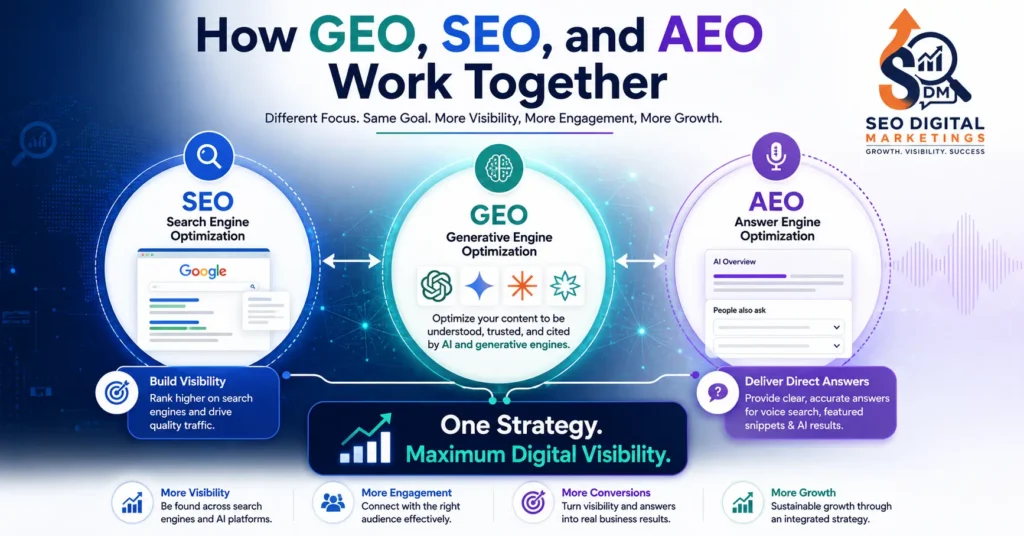
These three are not separate silos. Strong work in one area almost always helps the other two.
Clean structured data helps both AEO and GEO read your content correctly. A well-organized SEO foundation, meaning fast pages, clear headings, and solid internal linking, gives an AI model an easier time understanding what your site covers. Search engines have said openly that many of the same signals that help SEO also shape how AI models judge and cite a source.
In short, GEO builds on SEO rather than replacing it. A site with weak SEO rarely performs well in GEO either, since AI models still lean on crawlable, well-structured, authoritative content as source material.
Which One Does Your Business Need Right Now?
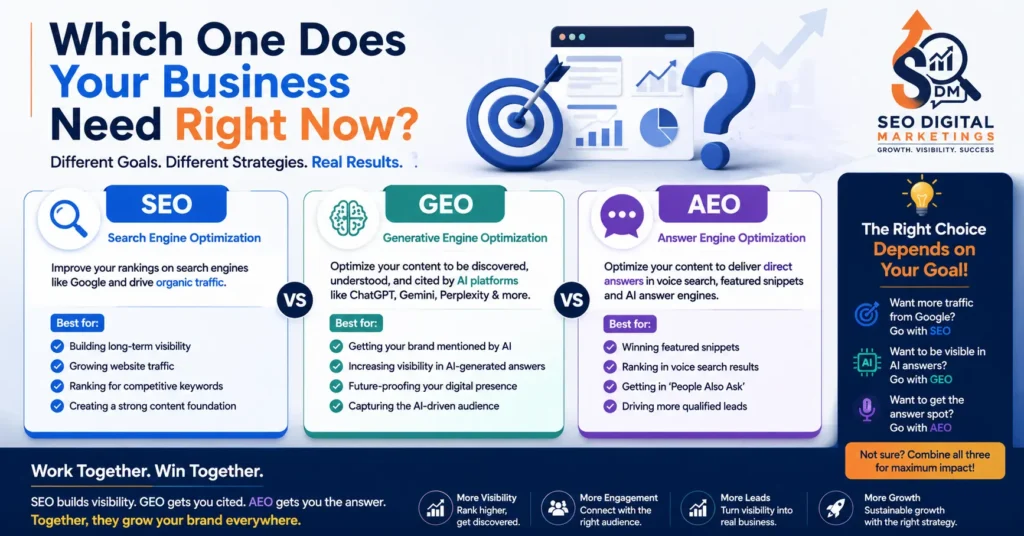
The right starting point depends on where your customers already search.
- If most of your traffic comes from Google search results, put SEO first.
- If your audience asks direct questions through voice search or search boxes, add AEO on top of your SEO work.
- If your buyers research products and services through ChatGPT, Perplexity, or Gemini before they ever open Google, GEO deserves real budget now.
Most businesses need all three working at once by 2026. At SEO Digital Marketing, we build campaigns that cover SEO, AEO, and GEO together instead of treating them as competing budgets, since customers move between all three search styles inside the same buying journey.
If you want a clear picture of where your brand stands across all three, our GEO optimization service starts with a full audit of your current SEO foundation, your snippet and schema coverage, and your visibility inside AI search tools.
Frequently Asked Questions
Is GEO the same as SEO?
No. SEO ranks your page in search results. GEO gets your brand mentioned or cited inside an AI-generated answer, which often skips the traditional ranking system entirely.
Is AEO part of SEO or a separate practice? AEO grew out of SEO and still depends on many SEO basics like schema markup and content structure, but it targets a different result: the direct answer box instead of a ranked listing.
Do I need to pick just one of these three?
No. Most brands run SEO, AEO, and GEO together, since each one captures a different type of search behavior and customers move between all three.
Which matters more in 2026, SEO or GEO?
Both matter, but the right mix depends on your audience. B2C brands with high search volume still lean on SEO. B2B and service brands are seeing faster growth from GEO as buyers research through AI tools earlier in their journey.
What is AIO and how does it connect to GEO?
AIO stands for Artificial Intelligence Optimization. Many agencies, including Seer Interactive, use it as another name for GEO. The core work stays the same: making your content easy for AI models to find, understand, and cite.
Can one team handle SEO, AEO, and GEO at the same time?
Yes, and it works better that way. The three disciplines share tools like schema markup, content structure, and entity clarity, so a single strategy across all three avoids duplicate work and conflicting priorities.
How do I measure AEO success versus GEO success?
AEO success shows up as snippet ownership and voice search wins, tracked through rank tracking tools. GEO success shows up as citation frequency and brand mention rate inside AI platforms, tracked through AI visibility monitoring tools built for that purpose.
Will GEO eventually replace SEO?
Unlikely any time soon. AI models still rely on crawlable, well-structured web content as source material, so SEO fundamentals remain the base that GEO builds on top of.