
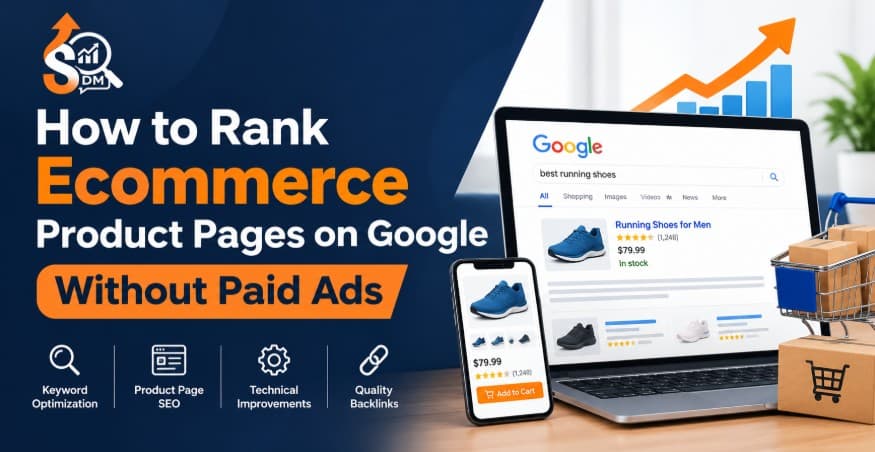
Most ecommerce store owners pour money into Google Ads the moment organic traffic stalls. But here is what the data actually shows: <cite index=”14-1″>organic search drives 33% of all ecommerce traffic, more than paid ads, email, or social media combined.</cite> The stores winning that organic traffic are not the ones with the biggest ad budgets. They are the ones that built their product pages the right way.
This article shows you exactly how to rank ecommerce product pages on Google without spending a cent on ads. You will learn the framework, the technical setup, the content approach, and the link strategy that moves product pages from page three to page one.
Why Most Product Pages Never Rank (And It Is Not Google’s Fault)
Store owners build product pages for shoppers, not for search engines. That sounds logical until you realise Google cannot buy from you. It can only read your page and decide whether it answers a searcher’s question better than every other result.
Most product pages fail that test for the same reasons, in the same order.
The first problem is copied manufacturer descriptions. When you paste the same product description that fifty other stores already published, Google has no reason to choose your version over theirs. <cite index=”17-1″>Google’s March 2027update specifically demoted thin pages that restated product feeds without insight.</cite> Copying the manufacturer text is the fastest way to stay invisible.
The second problem is targeting keywords that do not match what Google wants to show. <cite index=”12-1″>If you search your target keyword in incognito mode and Google is returning guides or comparison articles, your product page will not rank for that keyword no matter how well optimised it is.</cite> Google decides the intent behind a search. Your job is to match it.
The third problem is isolation. Most product pages sit alone with no internal links from blog content, no backlinks from outside websites, and no connection to the rest of the store. Google treats authority like water. It flows through links. A product page with nothing flowing into it stays dry.
Fix these three problems and you are already ahead of most stores online.
The Product Page SEO Framework That Actually Works
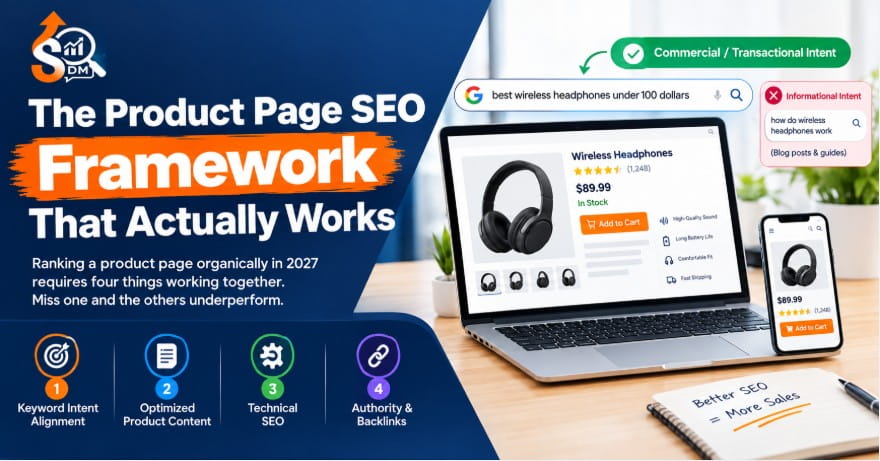
Ranking a product page organically in 2027 requires four things working together. Miss one and the others underperform.
The first is keyword intent alignment. Every product page needs one primary keyword that matches what Google calls a commercial or transactional intent. Terms like “best wireless headphones under 100 dollars” or “waterproof running shoes women” signal buying intent. Google returns product pages for these searches. Terms like “how do wireless headphones work” signal informational intent. Google returns blog posts and guides. Target the wrong type and your product page will never rank, regardless of how good the content is.
The second is unique, specific product content. Write at least 300 words of original copy on every product page. Not feature lists. Not bullet points copied from the spec sheet. Actual sentences that explain who this product is for, what problem it solves, and what makes it different from similar options. <cite index=”10-1″>Write conversationally, like talking to a friend who knows nothing about the products, and include semantically related terms so the page ranks for multiple related keywords, not just the primary one.</cite>
The third is technical correctness. Title tag, meta description, H1 heading, image alt text, URL structure, and page speed all need to be right. These are not ranking factors on their own. They are the foundation everything else sits on. Get them wrong and the content work matters less.
The fourth is authority. A product page with no links pointing to it needs to earn them, either from your own blog or from external websites. We cover both later in this article.
Writing Product Descriptions That Rank and Convert
A product description that ranks and converts does one thing: it answers the buyer’s real question before they ask it.
Most buyers arrive at a product page with a version of the same question in their head. Will this work for me? Before they read price, before they check shipping, they are scanning the description for evidence that this product fits their specific situation.
Write the first paragraph of every product description to answer that question directly. Name the person this product is for. Name the situation it solves. Name the outcome they will get. Then go deeper.
Good product descriptions for SEO include three layers. The first layer covers what the product is and who it is for. The second covers how it works and what makes it effective. The third covers specifics: materials, dimensions, compatibility, what is in the box. Each layer adds content that answers a different searcher’s question and gives Google more signals to match your page to relevant queries.
Keep sentences short. Avoid passive voice. Cut words that add length but not meaning. A 400-word product description that is dense with specific, useful information outranks a 1,000-word description filled with generic phrases like “premium quality” and “perfect for any occasion.”
One more thing: <cite index=”10-1″>meta descriptions do not directly boost rankings, but they increase click-through rates that can improve your position over time.</cite> Write every meta description as a short, specific pitch for your product. Treat it like a two-line ad. Make the person reading it feel like clicking is the obvious next step.
Optimizing Product Images for Google Image Search
Product images are a ranking opportunity that most stores leave completely unused.
Google Image Search sends real, buying-intent traffic to product pages. Someone searching “navy blue chelsea boots women” in Google Images and clicking through to your product page is a warm lead. Getting that traffic costs you nothing beyond the time it takes to optimise your images correctly.
Start with file format. <cite index=”11-1″>Resize and compress every product photo to WebP or AVIF format, write a descriptive alt text sentence for every image, enable lazy loading on product grids and gallery shots, and set srcset breakpoints so images scale correctly to any screen size.</cite>
Alt text is where most stores get lazy. “product-image-1.jpg” tells Google nothing. “Navy blue leather chelsea boots with stacked heel women size 7” tells Google exactly what the image shows and connects it to real search queries. Write alt text like you are describing the image to someone who cannot see it. Be specific. Include the product name, colour, material, and any other detail that matches how buyers search.
Page speed matters more for product pages than almost any other page type. <cite index=”17-1″>A one-second improvement in mobile speed lifts conversion rates by approximately 7%.</cite> Slow product pages lose customers and lose rankings at the same time.
Using Product Schema to Win Rich Snippets
Rich snippets are the extra information you see under some search results, like star ratings, prices, and stock availability. They make your listing stand out in a page full of plain blue links.
<cite index=”14-1″>Product structured data that enables price, rating, availability, and review count in search results increases organic click-through rates by an average of 30% compared to standard results.</cite> That is a 30% improvement in traffic to the same page, from the same position, with no additional ranking work.
Product schema tells Google what your page contains in a language search engines read perfectly. Add it to every product page and include the following properties at minimum: name, description, image, brand, SKU, price, currency, availability, and aggregate rating if you have reviews.
In 2027, schema does more than earn rich snippets. <cite index=”12-1″>Product pages that lack structured signals that AI systems can read will miss a growing share of buyer intent from Google AI Overviews, ChatGPT Shopping, and Perplexity.</cite> A page that ranks in traditional search but cannot be read by AI recommendation systems is leaving traffic behind. Get your schema right and you compete in both places.
Most ecommerce platforms handle basic product schema automatically. Shopify, WooCommerce, and BigCommerce all generate some structured data by default. The problem is that default schema is often incomplete. Check your implementation with Google’s Rich Results Test and fill in every missing property.
Internal Linking From Blog to Product Pages — The Strategy Most Stores Miss
This is the highest-return SEO activity available to any ecommerce store, and the vast majority of stores never do it properly.
Here is how it works. A blog post that ranks well on Google accumulates authority. Every link inside that blog post passes a portion of that authority to wherever it points. When you link from a high-traffic blog post to a product page using descriptive anchor text, you transfer ranking power directly to that product page.
<cite index=”14-1″>Contextual links from high-traffic blog content to relevant category and product pages transfer significant link equity and represent one of the highest-ROI ecommerce SEO tactics available.</cite>
The approach is straightforward. Write blog content that targets informational keywords your buyers search before they are ready to purchase. “Best running shoes for flat feet,” “how to choose chelsea boots,” “what to look for in a waterproof jacket” are all examples of informational searches that land buyers on content before they reach a product page. Inside that content, link naturally to the relevant product pages using anchor text that describes what the product is.
One blog post linking to five product pages moves authority to all five. Ten blog posts linking to the same product page compound that effect. Over six to twelve months, a consistent internal linking strategy from blog content can move product pages that were stuck on page three to the top of page one.
The anchor text matters. “Click here” passes authority but no keyword signal. “Waterproof running shoes for women” passes both. Use descriptive, keyword-rich anchor text that matches how buyers search for the product you are linking to.
How to Build Links to Product Pages Without Paid Outreach
External links from other websites are still one of the strongest ranking signals Google uses. Building them to product pages specifically is harder than building them to blog content, but it is possible without paying for placements.
The most reliable method is digital PR. Create something genuinely interesting around your product and get it covered. A study your store ran, data you collected from customers, a product comparison that media outlets find useful. These earn links naturally because they give journalists and bloggers something worth referencing.
The second method is finding broken links on other websites. Use a tool like Ahrefs or Semrush to find websites in your niche that link to product pages that no longer exist. Reach out and offer your product page as a replacement. The site owner benefits because their broken link gets fixed. You benefit because you earn a real link to your product page.
The third method is unlinked brand mentions. Search for times your brand or product name appears on other websites without a link. Contact the site owner and ask them to add one. They already mentioned you. Most will be happy to link.
The fourth method is supplier and manufacturer links. If you stock products from brands or manufacturers, ask them to link to your store from their “Where to Buy” or “Authorised Retailers” page. These links carry strong topical relevance and are easy to earn because both parties benefit.
None of these methods require a paid placement. They all require time and consistency. Even five to ten good external links pointing to a product page can push it significantly higher in the rankings.
Real Example: How SDM Ranked a Client Product Page in 90 Days
A UK-based ecommerce client came to SDM with a product page for a premium waterproofing spray that was sitting on page four of Google. The page had no unique content, no schema, no external links, and was isolated from the rest of the site with no internal links pointing to it.
In the first two weeks, we rewrote the product description from scratch. Three hundred and fifty words of original content covering who the product was for, what surfaces it worked on, how long results lasted, and how it compared to cheaper alternatives in plain, specific language. We added product schema including price, availability, and aggregate rating pulled from their review system. We fixed the image alt text across all six product photos and compressed images from an average of 1.4MB to under 120KB each.
In weeks three and four, we published two blog posts targeting informational keywords in the same niche. “How to waterproof outdoor gear before a trip” and “best fabric waterproofing sprays compared.” Both posts linked to the product page using descriptive anchor text. We also found three broken links on outdoor gear websites that pointed to discontinued products and secured replacements pointing to this product page.
By day 60, the page had moved from position 38 to position 14 for the primary keyword. By day 90, it reached position 6 and was generating consistent organic traffic for the first time.
The work took approximately twelve hours total across the 90-day period. No paid ads. No link purchases. No shortcuts.
That is what ecommerce product page SEO looks like when it is done correctly and consistently.
Your product pages are competing against stores that have been building authority for years. The gap closes faster than most store owners expect when the right technical foundation, content quality, and linking strategy are in place.
Talk to SDM about ranking your product pages. We offer a free consultation where we audit your top five product pages, identify exactly what is holding them back, and give you a prioritised action list. There is no obligation and no sales pitch. Contact us at contact@seodigitalmarketings.com or WhatsApp us at +8801948151384 to get started.