
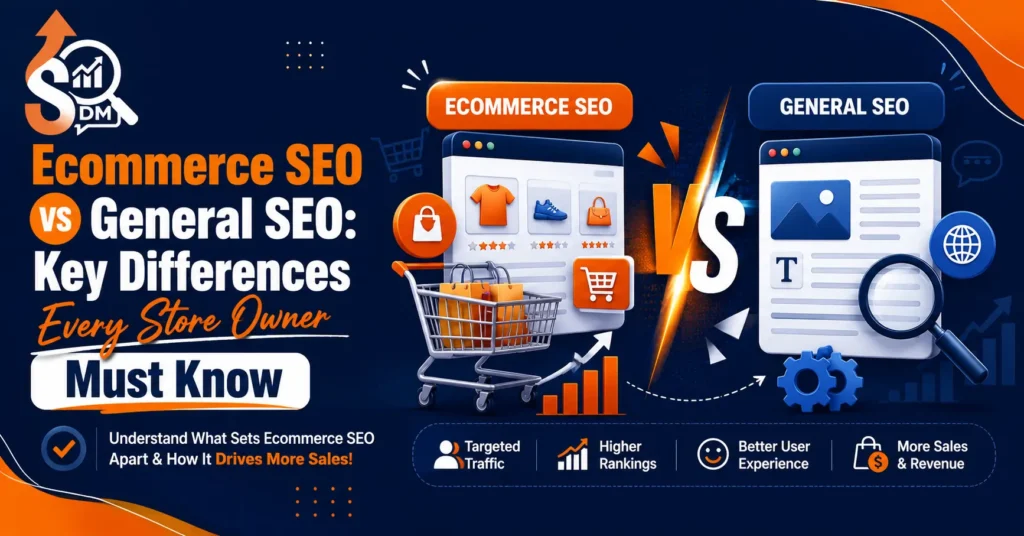
When you search Google for “how to clean leather shoes” versus “buy leather shoes online,” your intent is completely different. In the first search, you are looking for information; in the second, your credit card is practically in your hand, and you are ready to make a purchase.
This exact distinction is where General SEO and Ecommerce SEO part ways.
As an online store owner, treating your e-commerce platform like a standard informational blog is a recipe for high traffic but zero conversions. While general SEO focuses heavily on educating and engaging readers, Ecommerce SEO is laser-focused on turning casual browsers into paying customers. The strategies, technical frameworks, and success metrics of these two approaches are worlds apart.
If you want to scale your brand or online store and dominate Google’s search results, understanding these core differences isn’t just optional—it is critical to your survival in the digital marketplace.
Defining the Core Concepts
To understand how these two strategies clash and complement each other, we first need to break them down individually. Let’s look at what each SEO type actually does.
What is General SEO?
General SEO (often referred to as “content” or “informational” SEO) is the practice of optimizing a website to rank for broad, information-seeking search terms. Typically used by blogs, service providers, corporate websites, and news outlets, its primary goal is to build brand awareness, establish topical authority, and educate an audience.
The strategy relies heavily on long-form articles, guides, and case studies. Success is measured by how well you answer a user’s questions, keep them on your page, and guide them down a traditional marketing funnel.
What is E-commerce SEO?
E-commerce SEO is a highly specialized branch of search engine optimization designed specifically for digital storefronts. Its ultimate goal is not just to get eyes on a page, but to drive direct sales, reduce cart abandonment, and increase revenue.
Instead of just optimizing blog posts, Ecommerce SEO focuses on product pages, category pages, brand listings, and the checkout funnel. It requires a deep understanding of transactional search queries, commercial intent, and complex site architectures built to handle hundreds or thousands of moving inventory parts.
5 Critical Differences Between Ecommerce SEO and General SEO
Now that the foundational definitions are clear, let’s break down the five core pillars where General SEO and Ecommerce SEO completely diverge.
1. Search Intent & Keyword Strategy (Informational vs. Transactional)
The heart of any SEO strategy is keyword research, but the target intent varies drastically between these two models.
General SEO focuses on informational intent: Keywords usually begin with how to, what is, or tips for. For instance, a blog might target “how to maintain an espresso machine.” The user wants to learn, not buy.
Ecommerce SEO focuses on transactional and commercial intent: Keywords target users who are ready to purchase. They use modifiers like buy, best price, deals, or specific brand and model names—such as “Breville Bambino Plus espresso machine sale.”
Failing to recognize this difference means attracting visitors who read your content and leave without ever looking at a product.
2. Website Architecture & Navigation Complexity (The 3-Click Rule)
A standard blog or informational website usually has a flat, simple structure: Homepage $\rightarrow$ Blog Post Category $\rightarrow$ Blog Post.
E-commerce websites are highly complex digital ecosystems with hundreds, thousands, or even millions of pages. They require a strict hierarchical structure to ensure both users and search engine crawlers can navigate the site easily. The industry standard is the 3-Click Rule, meaning a user should be able to navigate from the homepage to any specific product page on the site within three clicks or fewer:
If your architecture is disorganized, search engine bots will struggle to crawl your store, leaving deep-tier product pages unindexed and invisible to shoppers.
3. Content Strategy (Blogs vs. Product & Category Pages)
In general SEO, content creation is relatively straightforward: you write comprehensive, long-form articles that dive deep into a specific topic to satisfy Google’s EEAT (Experience, Expertise, Authoritativeness, and Trustworthiness) guidelines.
In e-commerce SEO, the priority shifts away from traditional articles to optimizing category pages and product pages.
Category Pages act as individual department stores within your site. They must be optimized with high-intent introduction text, internal links, and structured filter options to rank for broad product terms.
Product Pages require unique, compelling copy that highlights features, benefits, specifications, and clear calls-to-action (CTAs). Copying and pasting manufacturer descriptions is a massive mistake that results in duplicate content penalties across your store.
4. Technical SEO Challenges (Faceted Navigation & Schema Markup)
Technical SEO is necessary for both formats, but e-commerce presents unique, advanced roadblocks that standard websites never encounter.
Faceted Navigation: E-commerce stores use filters (size, color, price, material) to help users browse. Every time a user checks a filter box, a new URL parameters string is generated. If left unchecked, this creates millions of duplicate URLs that waste your crawl budget and dilute link equity. Managing canonical tags, robots.txt directives, and noindex tags is a constant requirement.
Product Schema Markup: While blogs use Article or Recipe schema, e-commerce relies heavily on Product and Offer JSON-LD Schema. This structured data feeds Google real-time information regarding price, stock availability, and review ratings, allowing your listings to appear as eye-catching rich snippets directly in the search results.
5. KPI & Success Metrics (Traffic vs. Conversion & Revenue)
The way you measure success dictates how you invest your marketing budget.
General SEO Metrics: Success is evaluated using top-of-funnel indicators like organic traffic numbers, page views, time-on-site, bounce rates, and total keyword rankings.
Ecommerce SEO Metrics: Traffic is irrelevant if it doesn’t buy. E-commerce success is strictly measured by bottom-of-funnel KPIs, including Conversion Rate, Average Order Value (AOV), Cart Abandonment Rate, and Organic Revenue (ROI).
How to Handle Out-of-Stock Products Without Losing SEO Rankings
A major operational challenge unique to e-commerce stores is managing products that go out of stock, seasonal items, or permanently discontinued inventory. In General SEO, when a page becomes irrelevant, you simply delete it or update it. In e-commerce, mishandling a dead URL can permanently kill your rankings. The Golden Rules of Inventory SEO:
Temporarily Out of Stock: Keep the product page live. Clearly state when the item will return, offer an email notification sign-up for restocks, and suggest relevant alternative products. Do not remove the page or redirect it, as this causes unnecessary crawl errors.
Permanently Discontinued: If the page has high-quality backlinks and historic rankings, implement a 301 Redirect to the most relevant, current sub-category or the updated replacement model. If it has no SEO value, a clean 404 or 410 error page customized to guide users back to your main shop catalog is the best route.
Which One Does Your Business Need?
Choosing between these two strategies isn’t an either/or proposition; it depends entirely on your business model.
If your goal is to build an audience, run an affiliate marketing site, generate leads for a local service business, or establish thought leadership, general SEO is your framework.
However, if you own an online storefront, sell physical or digital inventory directly through a shopping cart, and rely on digital transactions to survive, you must deploy a dedicated e-commerce SEO strategy.
Note: The most successful e-commerce brands actually blend both. They build a rock-solid, technically sound e-commerce store framework first, and then integrate a General SEO blog strategy to capture top-of-funnel informational traffic, answering questions that gently nudge readers toward their product pages.
Conclusion
Treating an e-commerce store like a traditional informational website is one of the quickest ways to stall your online sales. While General SEO lays the groundwork for online visibility and authority, Ecommerce SEO provides the complex, high-conversion architecture required to transform search queries into predictable, scalable revenue.
By mastering transactional keyword intent, streamlining your 3-click site navigation, utilizing advanced product schema, and carefully managing your technical facets, you can build an online storefront that ranks high, converts traffic, and outpaces your competition.
Read more related article for: