
If you have ever received a proposal from an SEO agency and struggled to understand what you were actually paying for, you are not alone. The e-commerce SEO industry is full of vague promises, undefined deliverables, and packages that sound impressive but produce little measurable impact on your organic traffic or revenue.
This guide exists to fix that. We will walk through every component a professional e-commerce SEO service should include, explain what each one does, and show you exactly how to evaluate agencies before you sign a contract. Whether you are choosing your first SEO partner or replacing one that has underdelivered, this is the framework you need.
We work exclusively with e-commerce businesses across the UK, Denmark, and the US. The deliverables, red flags, and KPIs in this guide come directly from our own service delivery and from auditing dozens of stores that came to us after poor experiences elsewhere.
Quick navigation: Technical SEO → Category & Product Pages → Content Strategy → Link Building → How to Evaluate an Agency → Red Flags to Avoid
1. Technical SEO for Ecommerce: The Non-Negotiable Foundation
Every e-commerce SEO engagement should begin with a comprehensive technical audit. Without it, every other investment, content, link, and on-page optimization operates on an unstable foundation. Technical issues do not just limit your rankings; they can actively suppress them.
What a technical SEO audit covers
A professional e-commerce technical audit is not a 10-point checklist emailed as a PDF. For a store with hundreds or thousands of SKUs, a thorough audit covers:
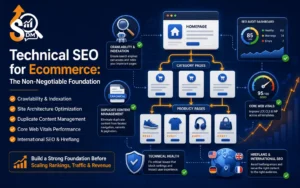
- Crawlability and indexation: Which pages Google can and cannot access. Identifying crawl budget waste from parameterized URLs, session IDs, and infinite scroll pagination.
- Site architecture: How your homepage, category pages, subcategory pages, and product pages are linked together. Poor architecture dilutes PageRank and makes it harder for Google to understand your most important pages.
- Duplicate content at scale: E-commerce platforms generate duplicate content automatically through faceted navigation, product variants, and pagination. A proper audit identifies every source and prescribes the correct fix: canonical tags, noindex, or robots.txt exclusion.
- Core Web Vitals: LCP, CLS, and INP measured across your product and category templates, not just the homepage. Platform-specific fixes for Shopify and WooCommerce are very different from each other.
- Hreflang for international stores: If you sell across multiple countries or in multiple languages, hreflang errors are among the most damaging and most commonly misimplemented technical issues.
Once the audit is complete, a professional agency provides a prioritized action plan: what to fix first for maximum impact, what can wait, and what requires developer resources versus what can be handled directly in your CMS.
Ask any agency: “Can I see an example technical audit you have delivered for an e-commerce client?” Their answer tells you everything about what you will actually receive.
2. Category and Product Page Optimisation
Category and product pages are the commercial engine of your e-commerce SEO strategy. They target buyers — people who already know what they want and are looking for a reason to purchase from you rather than a competitor. Getting these pages right is where ecommerce SEO directly drives revenue.
Category page optimisation
Category pages need to rank for high-volume commercial investigation and transactional keywords. The work involved is more complex than most store owners realize:
- Keyword mapping: Each category page should be mapped to a primary keyword cluster with clear commercial intent. This is not guesswork — it requires search volume data, competitor SERP analysis, and an understanding of buyer intent at each level of your navigation.
- Title tags and meta descriptions at scale: A store with 200 category pages cannot optimise these one at a time. A professional service builds templated logic that produces optimised titles automatically while flagging pages that need manual attention.
- On-page content: Google expects category pages to offer genuine value beyond a product grid. A short introductory paragraph (150–300 words) with naturally incorporated keywords, FAQs, and buying guide content all strengthen the page’s topical relevance.
- Internal linking: Category pages should receive internal links from blog posts, the homepage, and related category pages to concentrate PageRank where it matters most. See our full guide to internal linking strategy for e-commerce for details.
Product page optimisation
Product pages have a different set of requirements:
- Unique descriptions: Every product page needs original copy. Manufacturer descriptions copied verbatim across multiple retailers are a direct signal of thin content. Even 150 words of original, buyer-focused copy makes a measurable difference.
- Product schema markup: Structured data tells Google exactly what your product is, what it costs, whether it is in stock, and what customers think of it. Rich results with price and review stars consistently outperform plain blue links in click-through rate.
- Canonical strategy for variants: A product available in 6 colours and 4 sizes generates 24 potential URLs. Without a clear canonical strategy, each variant competes with the others and none of them rank effectively.
- Image optimisation: Product images are often the single largest contributor to slow LCP scores. Compression, next-gen formats (WebP, AVIF), and correct sizing for the display context are all part of a complete product page optimisation.
3. Content Strategy and Blog SEO
Content strategy is where e-commerce SEO becomes a compounding asset. Well-structured informational content attracts top-of-funnel traffic from buyers at the research stage, builds topical authority across your niche, and funnels PageRank to your commercial category and product pages through internal links.
Topical clusters, not random posts
Random blog posts written without a keyword strategy do not build topical authority. A professional ecommerce SEO service maps your content into clusters: a pillar page covering a broad topic, supported by cluster posts that address related subtopics in depth.
For example, a store selling outdoor footwear might build a cluster around ‘trail running shoes’: the pillar page targets the broad category keyword, while cluster posts cover ‘best trail running shoes for wide feet’, ‘trail running shoes vs road running shoes,’ and ‘how to choose trail running shoes’. Each cluster post links back to the relevant category page and to the pillar.
Content that converts, not just ranks
Traffic without conversion is vanity. Every piece of content in an ecommerce SEO strategy should have a clear conversion pathway: an internal link to a relevant category or product page, a contextual CTA, or a comparison table that guides the reader toward a purchase.
This is the difference between an SEO agency that writes content and an ecommerce SEO agency that understands the buyer journey.
What to expect as a deliverable
- Monthly content calendar: Topics chosen based on GSC impression data, keyword research, and topical gap analysis against your top competitors.
- Written and published posts: Minimum 1,000–2,000 words per post, with headers, internal links, and on-page optimisation applied at time of publication.
- Performance review: Monthly reporting on impressions, clicks, and ranking movement for published content.
4. Link Building for Ecommerce
Domain authority is still one of the strongest predictors of ranking position for competitive ecommerce keywords. Building it requires a consistent, white-hat link acquisition strategy — and it is one of the areas where the difference between a good agency and a bad one is most stark.
Link building strategies that work for ecommerce
- Supplier and brand pages: If you stock branded products, request a link from the manufacturer’s ‘where to buy’ or ‘authorised stockist’ page. These are highly relevant, editorially placed links that Google values highly.
- Digital PR: Original research, industry data, and expert commentary earn links from journalists and publishers at scale. A study on consumer purchasing trends published on your ecommerce blog can generate 20–50 referring domains from a single campaign.
- Resource and buying guide outreach: Identify existing ‘best X’ and ‘top Y’ articles ranking for your target keywords. Pitch your products or expertise to the authors for inclusion or mention. These contextual links carry strong relevance signals.
- Competitor backlink gap: Pull the referring domains linking to your top three competitors. Sites already linking to similar stores are your warmest outreach targets. A professional agency runs this analysis monthly and builds a pipeline of link opportunities.
What to expect as a deliverable
- Monthly link report: New referring domains acquired, their DA, relevance, and anchor text used.
- Link velocity target: A steady 8–20 high-quality referring domains per month is more valuable than 200 low-quality links acquired in a single burst.
- No PBNs, no link schemes: Any agency offering large volumes of links at low cost is using methods that create penalty risk. The recovery cost from a manual action or algorithmic penalty is far greater than the cost of doing it correctly.
Red flag: Any agency that cannot tell you specifically where your links will come from or that offers ‘100 links per month’ as a fixed package should be avoided. Link quality and relevance matter far more than volume.
5. How to Evaluate an E-commerce SEO Agency
Now that you know what a professional service includes, here is how to assess whether an agency can actually deliver it. The following questions will separate genuine specialists from generalists with an e-commerce page on their website.
Questions about process and transparency
- Can you show me a technical audit you have delivered for an ecommerce client? A redacted example tells you the depth of their analysis and whether their output is actionable or surface-level.
- How do you handle duplicate content from faceted navigation? This is an ecommerce-specific technical problem. If they look uncertain, they are not ecommerce specialists.
- What tools do you use and will I have access to the data? You should always have direct access to your own GSC, GA4, and any rank-tracking tools the agency uses on your behalf.
- What is your link building strategy and can you show me examples? They should be able to name specific outreach methods and show you real links placed for other clients.
- How do you report results and how often? Monthly reporting as a minimum, with clear attribution between agency activity and ranking or traffic movement.
Questions about results and commitment
- What KPIs do you track and how do you tie them to revenue? Rankings alone are not enough. A professional agency tracks organic sessions, organic revenue (via GA4), and conversion rate by landing page.
- What is a realistic timeline for results in my niche? An honest agency will give you a 3–6 month expectation with clear milestones. Anyone promising page-one rankings in 30 days is misleading you.
- Can you share an ecommerce case study with before/after data? GSC screenshots, ranking movement, and revenue attribution. Not just a testimonial.
- What happens to my assets if I stop working with you? All content, links, and data should be yours. An agency that ‘owns’ your content or restricts your GSC access is creating an unhealthy dependency.
- Is the contract rolling monthly or locked in? A confident agency offers rolling monthly agreements because they believe in their results. Long lock-in periods with difficult exit clauses are a warning sign.
Red flags that should disqualify an agency
| Red flag | Why it matters |
| Guaranteed #1 rankings | No agency can guarantee Google rankings. This promise signals either dishonesty or a reliance on black-hat methods that risk penalties. |
| 100 backlinks per month | Volume-based link packages use low-quality or artificial links. One high-quality editorial link outperforms 100 directory submissions. |
| No reporting or vague metrics | If an agency cannot show you exactly what they have done and what it produced, they cannot be held accountable. |
| No case studies or references | Any agency worth hiring has e-commerce clients willing to speak to results. The absence of proof is itself evidence. |
| Long lock-in with no exit clause | A 12-month minimum with no performance-based exit suggests the agency knows results may disappoint. |
| They own your content or data | Your GSC, GA4, content, and backlinks are your assets. An agency acting as a gatekeeper to your own data is a serious risk. |
What a Complete E-commerce SEO Service Looks Like
To summarize, a professional e-commerce SEO service should include all five of these components working together as a unified strategy:
| Service component | Key deliverable | Impact |
| Technical SEO audit | Prioritised fix list with developer-ready specs | Removes ranking blockers at source |
| Category & product page optimisation | Keyword mapping, titles, schema, canonicals | Directly drives commercial traffic |
| Content strategy | Monthly topical cluster posts with internal links | Builds authority and top-of-funnel traffic |
| Link building | 8–20 quality referring domains per month | Closes the authority gap with competitors |
| Reporting & analytics | Monthly GA4 + GSC dashboard with revenue attribution | Proves ROI and guides next actions |
Request a Custom Ecommerce SEO Proposal
We will review your current organic performance, audit your top competitors, and send you a tailored proposal showing exactly what we would do for your store and what results you can realistically expect.