
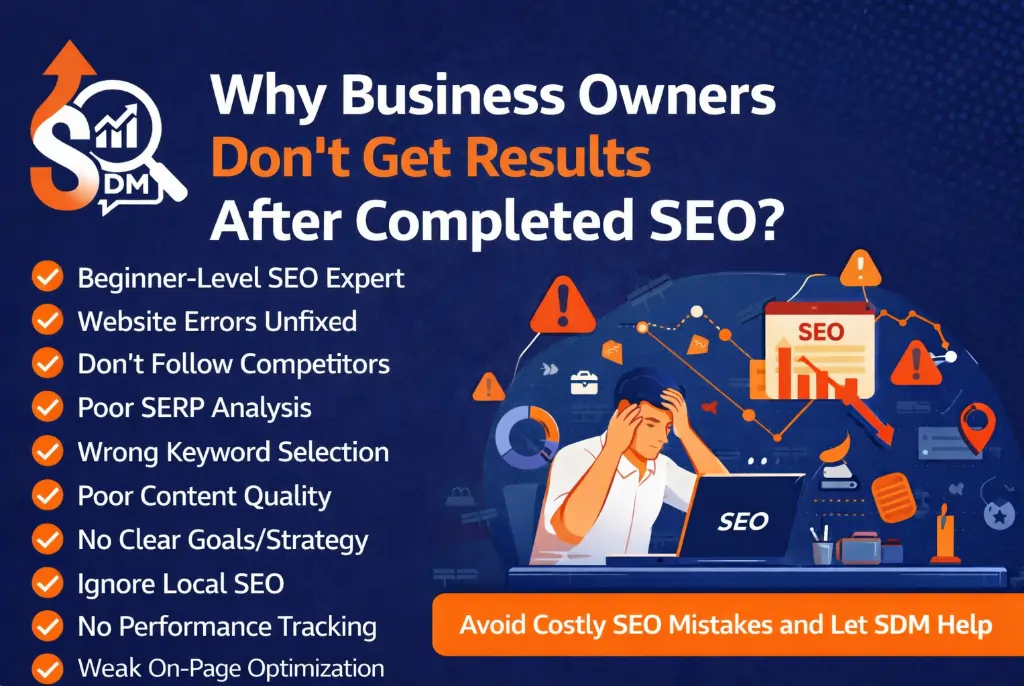
Many business owners invest in SEO expecting quick rankings and sales. But after months of work, they see little or no improvement. This usually happens because of poor strategy, wrong keyword targeting, weak content, or technical errors. SEO needs planning, expertise, and consistency not shortcuts.
Important Mistakes When Starting an SEO Project
Search Engine Optimization is not just adding keywords to a website. It is a complete digital marketing process that involves technical SEO, content strategy, competitor research, user intent, and performance tracking. When business owners ignore key steps at the beginning, results become slow or invisible.
Below are the most common mistakes that stop businesses from getting real SEO success.
1. SEO Work With a Beginner-Level SEO Expert
One of the biggest mistakes is hiring a low-cost, inexperienced SEO provider. Many beginners do not fully understand how Google Search works or how Google’s algorithm evaluates websites.
They may:
- Use outdated SEO tactics
- Build spam backlinks
- Stuff keywords unnaturally
- Ignore technical SEO
SEO is not just about ranking. It is about improving visibility, authority, and user experience. An experienced SEO team understands:
- Search intent
- Content depth
- E-E-A-T (Experience, Expertise, Authoritativeness, Trustworthiness)
- Conversion-focused strategy
Choosing the wrong expert can waste both time and money.
2. Website Errors Not Found at the Beginning
Before starting SEO, a full technical audit is necessary. Many websites have hidden problems such as:
- Slow page speed
- Broken links
- Crawl errors
- Indexing issues
- Poor mobile usability
If these issues are not fixed first, search engines cannot properly crawl or rank your site.
Using tools like Google Search Console and Google Analytics helps detect these problems early. Technical SEO is the foundation of ranking. Without it, content and backlinks will not perform well.
3. Not Following Competitors
SEO is competitive. If your competitors are ranking on page one, you must understand why.
Ignoring competitor research means you miss:
- Their keyword strategy
- Their content structure
- Their backlink sources
- Their internal linking system
By analyzing top competitors, you can find keyword gaps, content opportunities, and ranking improvements.
SEO is not working alone. It is competing in the same SERP (Search Engine Results Page).
4. Poor SERP Analysis
Many business owners do keyword research but forget SERP analysis.
SERP analysis means:
- Understanding search intent
- Checking what type of content is ranking
- Studying featured snippets
- Reviewing “People Also Ask” questions
For example, if Google shows blog posts for a keyword and you create a service page, it may not rank.
SEO is about matching user intent. Without proper SERP study, rankings become difficult.
5. Wrong Keyword Selection Page by Page
Another common mistake is targeting the same keyword on multiple pages or selecting keywords with:
- High competition
- No search intent
- Low relevance
Every page should target one primary keyword and related semantic keywords.
Keyword mapping is important. It ensures:
- No keyword cannibalization
- Clear topic relevance
- Strong content focus
Choosing the wrong keywords leads to traffic that does not convert.
6. Poor Content Quality
Content is the heart of SEO. But many businesses publish thin, copied, or low-value content.
Google prioritizes:
- Helpful content
- Original insights
- Clear structure
- User-focused answers
Content should:
- Solve user problems
- Answer real questions
- Include relevant keywords naturally
- Be easy to read
Low-quality content damages trust and reduces ranking chances.
7. Lack of Clear SEO Goals and Strategy
SEO without a strategy is like driving without a map.
Many businesses do not define:
- Target audience
- Conversion goals
- Location targeting
- Monthly KPI tracking
A clear SEO strategy should include:
- Keyword roadmap
- Content calendar
- Technical optimization plan
- Link-building strategy
Without direction, results become random.
8. Ignoring Local SEO Opportunities
For local businesses, ignoring local SEO is a big mistake.
Optimizing your Google Business Profile and using local keywords can bring high-converting traffic.
Local SEO includes:
- NAP consistency (Name, Address, Phone)
- Local citations
- Customer reviews
- Location-based keywords
If you serve a specific area, local search optimization is essential.
9. No Performance Tracking
Many business owners do SEO but never measure performance.
Without tracking:
- You don’t know which keywords rank
- You don’t know which pages convert
- You don’t know what needs improvement
Tools like Google Analytics and Google Search Console provide data about:
- Organic traffic
- Click-through rate (CTR)
- Bounce rate
- Ranking position
SEO is data-driven. Decisions must be based on performance metrics.
10. Weak On-Page Optimization
On-page SEO remains a ranking factor.
Weak on-page optimization includes:
- Missing meta titles
- No meta description
- Poor header structure (H1, H2, H3)
- No internal linking
- Unoptimized images
Each page should have:
- Optimized title tag
- Proper header hierarchy
- Keyword placement in first 100 words
- Relevant internal links
On-page SEO helps search engines understand your content better.
11. No Consistency in SEO Efforts
SEO is not a one-time job.
Many businesses:
- Stop after 2–3 months
- Publish content irregularly
- Build backlinks once and stop
SEO needs consistent:
- Content updates
- Backlink growth
- Technical monitoring
Search engines reward websites that show long-term value and activity.
12. Low-Quality Backlinks
Backlinks still matter. But quality is more important than quantity.
Low-quality backlinks:
- Come from spam sites
- Are irrelevant to your niche
- Look unnatural
These can even cause penalties.
A good backlink strategy focuses on:
- Relevant websites
- Guest posting
- Authority domains
- Natural link growth
Quality backlinks build trust and authority.
Why Work With SDM?
If you want real SEO results, you need the right team.
SDM has a strong and experienced SEO team. We do not follow shortcuts. We follow Google’s rules and focus on long-term growth.
At SDM, we:
- Understand your business goals
- Study your target audience
- Analyze user behavior
- Perform deep keyword research
- Conduct technical SEO audits
- Create high-quality, user-focused content
- Build authority with ethical backlink strategies
- Track and improve performance monthly
We believe SEO is not only about ranking. It is about:
- Increasing qualified traffic
- Building brand authority
- Improving conversion rate
- Delivering measurable ROI
Our strategy is based on E-E-A-T principles — Experience, Expertise, Authoritativeness, and Trustworthiness. We aim to build websites that both users and search engines trust.
Final Thoughts
If your SEO campaign did not bring results, do not think SEO does not work. In most cases, the problem is strategy, execution, or consistency.
SEO is a long-term investment. When done correctly with proper planning, expert knowledge, competitor analysis, and consistent effort, it can transform your business growth.
Avoid the common mistakes. Focus on quality. Follow data. And work with a professional team like SDM to achieve sustainable success.